“Safe and Secure Campus” Awareness Series

5 Awareness Workshops • One Mission • Safer Institutions.

Educational institutions today are required to address a wide range of legal, regulatory and institutional responsibilities concerning the safety, dignity, privacy and well-being of their campus communities.

Recognising the importance of strengthening awareness in these areas, Surakshitam and EduLegal are pleased to present the “Safe and Secure Campus” Awareness Series.

The series is intended to provide an informed and practical understanding of key issues that educational institutions encounter in their day-to-day functioning. It places emphasis on legal requirements, institutional procedures, compliance responsibilities and good practices.

The workshops are designed to facilitate meaningful engagement with these subjects through practical perspectives, real-world considerations, legal insights, interactive discussions and best practices relevant to educational institutions.

We cordially invite your institution and its stakeholders to participate in this initiative and benefit from the discussions.

A safe campus is strengthened by awareness, preparedness and institutional responsibility.

We look forward to your participation in this important initiative towards building safe, respectful, inclusive and secure educational institutions.
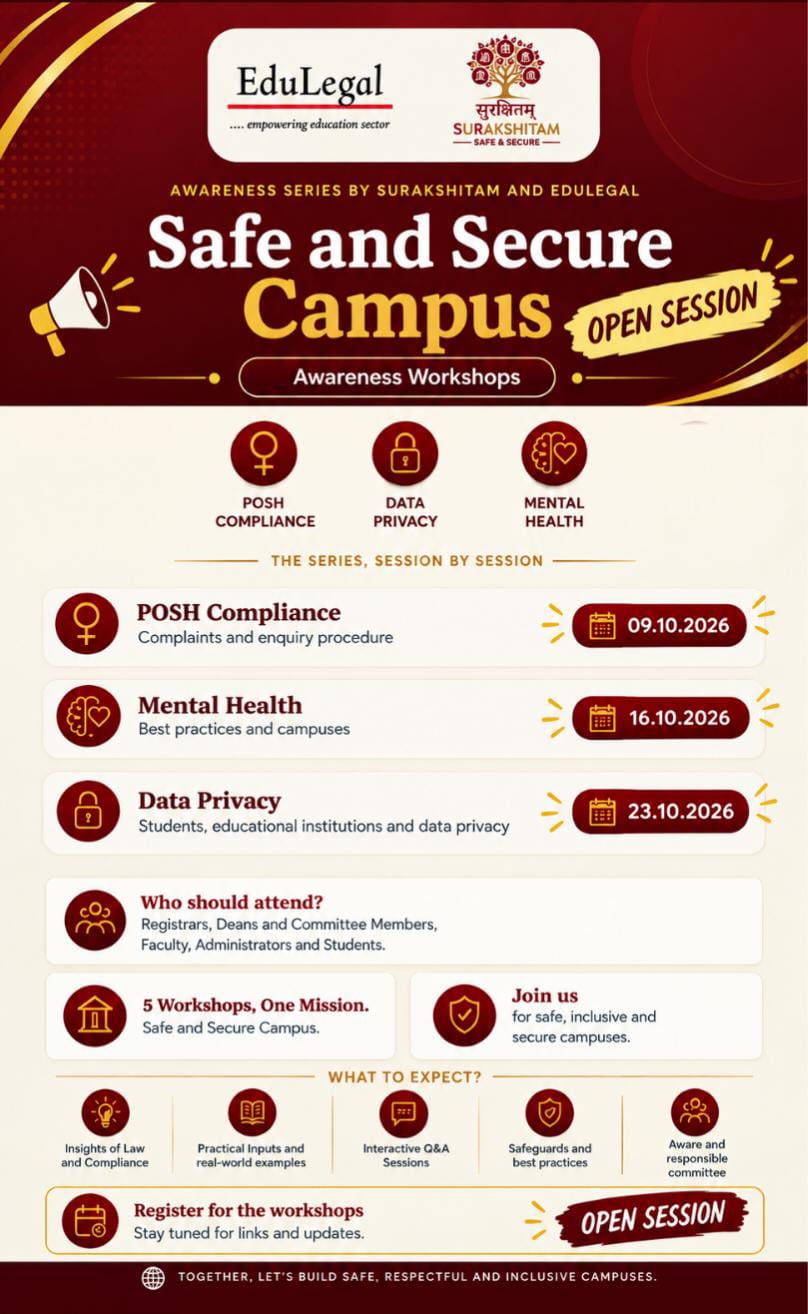
Safe and Secure Campus Awareness Series by Surakshitam and EduLegal — 5 Awareness Workshops
Topics Interested in *

You may choose more than one option.

Selecting a topic will let you add an optional question for that session.

Please select a topic

Please select at least one topic before submitting the form.

Please post a query for the session. It will help us in curating the topics which we need to address in the webinar.
From Previous Sessions

Photos and recordings from earlier workshops in the Awareness Series.

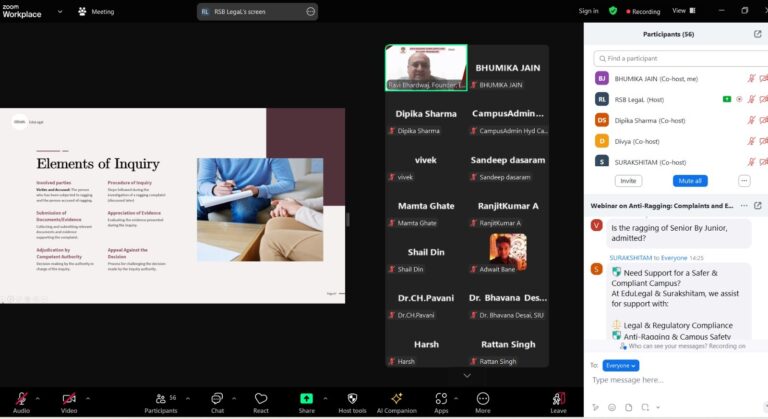
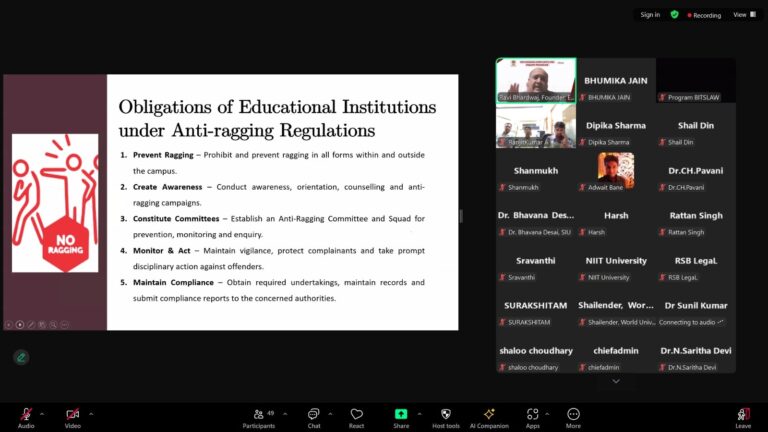
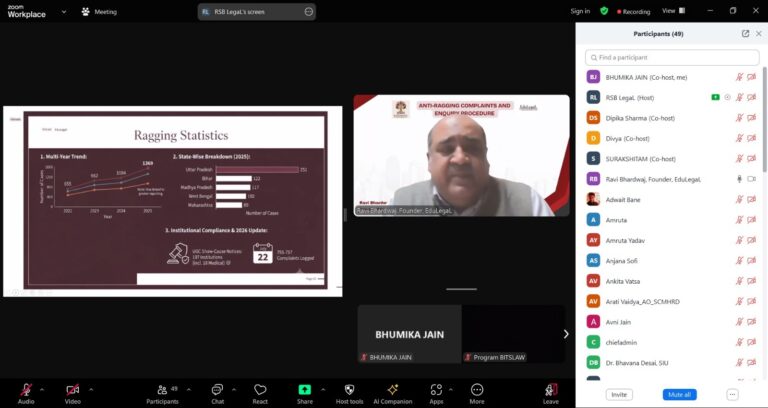
Anti Ragging sessions conducted on 11th September 2026 by Ravi Bhardwaj

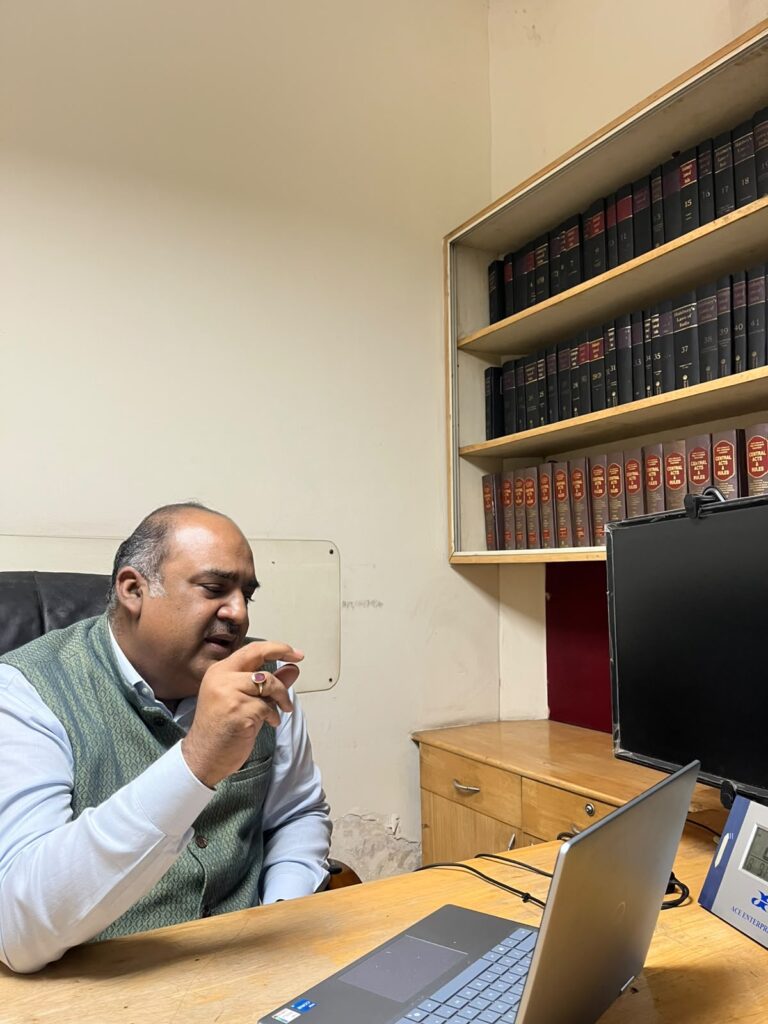
Session on PoSH Laws conducted on 9th October 2026 by Adv Ravi Bhardwaj

Frequently Answered Questions by Participants

Digital Evidence

Participant question “How do courts view digital evidence like WhatsApp chats and screenshots? Do they hold good in court — and if yes, under what circumstances?”

Indian courts do accept digital evidence, but only when it clears a few legal hurdles. The framework is the Information Technology Act, 2000 and the Indian Evidence Act, now updated as the Bharatiya Sakshya Adhiniyam, 2023. Courts look at three things: authenticity — can the sender and receiver be identified; integrity — has the record remained unedited and untampered; and procedural compliance — is it backed by the required certification when disputed. Institutional committees — Anti-Ragging Committees and PoSH Internal Committees — must satisfy themselves on authenticity before relying on a digital record.

In practice, it comes down to three situations a committee is most likely to meet:

The defending student admits it

It is admitted immediately. Take a common situation. A senior student is called before the Anti-Ragging Committee. The complaining student shows a WhatsApp screenshot of threatening messages. The Committee asks, “Did you send this?” He replies, “Yes, I sent it, but I was just joking.”

Once the defending student admits sending the message, the screenshot is accepted as genuine. No further technical validation is needed, and the Committee can turn entirely to what the message means and what action to take.

The message is on the defending student’s own phone

It is admitted, with no further steps needed. A female student complains of inappropriate messages from a male student on Instagram. During the enquiry the Internal Committee asks the defending student to show his phone, and the messages are found in his sent folder — word for word matching the complainant’s screenshots.

He could not deny that the phone was his, that he sent the messages, or claim the phone was in someone else’s possession at the time. Evidence found on the defending person’s own device speaks for itself, and the Committee can rely on it directly.

The defending student denies everything

A screenshot alone will not be admitted easily. A first-year student files a ragging complaint and shows the WhatsApp chat on her phone. The defending senior says, “That screenshot is fake. I never sent that. She could have faked it herself.”

A standalone image can be disputed — anyone can type a fake conversation, and online fake-chat generators make this trivial. This is where the Committee needs more than the picture.

Preserving the evidence — what to do from the start
  • Take a screen recording of the conversation. A video scrolling through the actual chat is far harder to dispute than a static screenshot.
  • Note the identifying details visible on screen — phone number, profile photograph, handle and “last seen” timestamp.
  • Do not delete the original chat. Keep it on the original device and do not clear the application cache.
  • Arrange a Section 65B certificate with your legal advisor if the matter may go further.
What a Section 65B certificate is, and when you need one

Think of it this way. If you print a photograph, a court will ask: is this the original, or has it been edited? A Section 65B certificate is a signed statement from a responsible person — the IT head, the system administrator, or the device owner — confirming that “this electronic record is genuine, was produced by a properly functioning device, and has not been tampered with.”

For an Internal Committee or Anti-Ragging Committee, you do not generally need this certificate for your internal enquiry. But if the matter ever reaches a police complaint, a court, or a UGC appeal, and the defending student or faculty member denies the messages, the certificate becomes very important. Without it, a court may refuse to look at the evidence at all.

The practical reality is that most committees do not have an IT team on standby. So the simple rule is: preserve everything on the original device, get a screen recording where possible, and if the matter is serious enough to go to the police, involve your legal counsel.

The three-step rule for your committee
  1. Ask the defending student or faculty member whether they accept the message as genuine. If they do, record that acceptance in your minutes. That alone is sufficient.
  2. If denied, ask the complaining student whether the original is still on their device. Do not allow deletion, and request a screen recording if one has not been made yet.
  3. If the matter may go beyond the institution, minute a recommendation that a Section 65B certificate be obtained with the help of the institution’s legal advisor.

You do not need to be a technical expert. Your job is to preserve the evidence carefully and record what you did. The legal steps, if needed, will follow.

Is There Any Certification to Become a PoSH Trainer?

Participant question “Is there any certification to become a PoSH trainer?”

There is currently no government-authorised or statutorily mandated certification for PoSH trainers in India. Neither the PoSH Act, 2013 nor its Rules prescribe a certifying authority, a fixed curriculum, or a mandatory qualification for conducting PoSH training. In the absence of an official framework, law firms, HR consultancies and boutique training organisations have developed their own certification programmes — several are useful as a structured introduction to the law and case studies, and can be a good place to start.

A certificate on its own does not make someone an effective PoSH trainer, though. Good facilitation in this space draws heavily on lived, practical experience — having sat through real inquiries, understood how institutions actually respond under pressure, and learned to translate the law into examples a room full of people will relate to. That judgment is built over time, through exposure to real cases and real institutions, not from a course alone.

If you’re considering this path
  1. Foundation, not finish. Treat a certification course as a starting point — useful for structured grounding in the law, not a substitute for practice.
  2. Practitioner-led. Look for a course led by practitioners with real inquiry or Internal Committee experience, not purely academic instruction.
  3. Case-based learning. Prioritise programmes that include case studies, mock inquiries, or scenario-based facilitation over lecture-only formats.
  4. Shadow before you solo. Where possible, shadow or assist an experienced trainer or IC member before facilitating independently — this is where most real learning happens.
Can a Junior File a Ragging Complaint in the Fourth Year?

Participant question “How long will a fresher stay Junior in the college? Can a Junior file a case, say in the fourth year, for current or previous ragging?”

“Junior” is an informal, social label tied to the year of admission, not a status the law recognizes. There is no rule that the right to report something is only valid while being “the junior.” A student in the 4th year is exactly as much a “student of the institution” as in the 1st — nothing about that changes.

On filing a case in the 4th year for something from an earlier year, there are two routes:

Institutional / UGC route

Unlike PoSH, which has a 3-month window extendable by 3 more, the UGC Anti-Ragging Regulations, 2009 do not prescribe a fixed cutoff for when a student must report. The Regulations focus on how fast the institution must act once it receives a complaint — an FIR within 24 hours and remedial action within 7 days — not on a bar on when the student can come forward.

A long gap can limit what the institution can still do (for example, if the person involved has already graduated), but the institution can and should still record the complaint, investigate, and act where possible.

Criminal / police route

This depends on which specific offence applies to what actually happened. Ragging itself is not a standalone IPC/BNS offence. Cases are filed under whichever sections fit — wrongful restraint, criminal intimidation, causing hurt, outraging modesty, abetment to suicide, and so on. Each carries its own limitation period under Section 514 BNSS (formerly Section 468 CrPC):

  • Fine-only offences: 6 months
  • Up to 1 year imprisonment: 1 year
  • 1–3 years imprisonment: 3 years
  • More than 3 years imprisonment: no limitation bar at all — relevant for serious ragging cases such as grievous hurt, abetment to suicide and attempt to murder.
What if the delay is beyond the limitation period?

Even where a limitation period technically applies, courts have discretion under Section 519 BNSS to condone delay if there is a genuine, satisfactory reason. Fear of retaliation or academic consequences while still enrolled is a reason courts have recognized before.

Under Which Provision Can Students Be Inducted into the PoSH Committee?

Participant question “Under which section/sub-section can students be inducted in the PoSH Committee?”

This is a provision specific to Higher Educational Institutions (HEIs). It does not exist in the PoSH Act, 2013 itself — Section 4 of the Act, which governs a standard corporate Internal Committee, has no student-member category, since the Act is written around “employees.” The UGC Regulations add it specifically for higher educational institutions.

The source is Regulation 4(1)(c) of the UGC (Prevention, Prohibition and Redressal of Sexual Harassment of Women Employees and Students in Higher Educational Institutions) Regulations, 2015.

How the committee is made up under Regulation 4(1)
  • 4(1)(a) — Presiding Officer (senior woman faculty member)
  • 4(1)(b) — Two faculty members and two non-teaching employees
  • 4(1)(c) — Three students (UG, PG and research scholar), elected — only where the complaint involves a student
  • 4(1)(d) — One external member (NGO or legal background)
Student members are conditional, not automatic

Three students are to be included on the IC/ICC if the matter involves a student — one each at the undergraduate, master’s and research scholar level. They are elected through a transparent, democratic procedure, not nominated by the administration (unlike the faculty and non-teaching staff members).

They are required only when the specific complaint being heard involves a student, as complainant or respondent. They are not permanent standing members for every case — for example, a pure staff-versus-staff matter does not need them.

Is a Psychologist Mandatory at Each College?

Participant question “Is there any mandatory requirement for a psychologist at each College?”

Colleges with 100 or more students must appoint at least one qualified mental health professional — a counsellor, psychologist or social worker with training in child and adolescent mental health. Smaller institutions do not need an in-house appointment, but must set up access to an external mental health professional.

Where this comes from, and why it matters

This is not a UGC regulation in the traditional sense. It originates from the Supreme Court’s judgment in Sukdeb Saha v. State of Andhra Pradesh (July 2025), arising from a NEET aspirant’s suicide case. The Court issued nationwide guidelines to prevent student suicides, making it mandatory for all institutions to adopt a mental health policy. It stated that these measures remain in effect and binding until proper legislation or regulatory frameworks are established.

This is binding law right now, not just guidance, pending a formal statute. The bench directed that all educational institutions with 100 or more students must appoint or hire at least one qualified counsellor, psychologist or social worker with proven training in child and adolescent mental health.

How UGC has since operationalized this for colleges

On 13 January 2026, UGC circulated its Guidelines on a Uniform Policy on Mental Health & Well-Being for Higher Educational Institutions, prepared by an expert committee. These guidelines require each HEI to establish a dedicated Mental Health & Well-being Centre with appropriate infrastructure for private and accessible services. They mandate one mental health professional for every 100 students, with UGC monitoring implementation through a dedicated portal named MANAS-SETU.

By March 2026, UGC formally directed HEIs to establish Student Services Centres, functioning as a single-window support system equipped with trained counsellors and mental health professionals.

Steps Involved in Anti-Ragging

Participant question “Steps involved in anti-ragging”

The ten core steps
  1. Prevent Ragging – Prohibit and prevent ragging in all forms, within and outside the campus.
  2. Create Awareness – Conduct awareness sessions, orientation, counselling and anti-ragging campaigns.
  3. Constitute Committees – Establish an Anti-Ragging Committee and Squad for prevention, monitoring and enquiry.
  4. Monitor & Act – Maintain vigilance and take prompt disciplinary action against offenders.
  5. Maintain Compliance – Obtain required undertakings, maintain records, and submit compliance reports to the concerned authorities.
  6. Display Information – Display anti-ragging rules, penalties, helpline numbers and contact details prominently across the institution.
  7. Provide Complaint Mechanism – Establish accessible and confidential channels for reporting incidents of ragging.
  8. Ensure Immediate Action – Take prompt preventive and remedial action upon receiving any complaint or information regarding ragging.
  9. Protect Victims & Witnesses – Ensure the safety, confidentiality and necessary support of victims and witnesses.
  10. Report to Authorities – Report serious incidents to the police and other competent authorities, wherever required.
Anti-Ragging Enquiry Procedure

Participant question “Anti-ragging and enquiry procedure”

The five-stage procedure
  1. Receive Complaint – The complaint is received from the victim, parent, student, staff or any person aware of the incident.
  2. Immediate Enquiry – The Anti-Ragging Squad conducts an on-the-spot enquiry, gathers facts and ensures the victim’s safety.
  3. Report to Committee – The Squad submits its findings and enquiry report to the Anti-Ragging Committee.
  4. Committee Enquiry & Decision – The Committee examines the evidence, hears the accused and determines appropriate action.
  5. Action & Closure – Disciplinary action is taken as per applicable rules; serious or criminal matters are reported to the competent authorities, and records are maintained.
Principles the enquiry must follow
  • Right to a Fair Hearing – an impartial, just process for everyone involved.
  • Right to be Heard (Audi Alteram Partem) – both the complainant and the accused get a genuine opportunity to present their case.
  • Right to Information & Inspection – access to the material and evidence the enquiry relies on.
  • Right to Identity Protection – safeguarding identities to prevent retaliation or stigma.
  • Right to Appeal – recourse against the Committee’s decision, typically through the institution’s broader disciplinary appeal mechanism (Vice-Chancellor/Governing Body), since the UGC Regulations do not create a separate anti-ragging-specific appellate tier.
What Is the Punishment for Students Who Do Ragging?

Participant question “What is the punishment for students who do ragging?”

Punishment for ragging works on two separate tracks, both of which can apply to the same incident: institutional (administrative) punishment under the UGC Regulations, and criminal liability under general penal law.

1. Institutional punishment — UGC Regulations, 2009 (Regulation 9)

Based on the nature and gravity of the offence, the Anti-Ragging Committee can impose any one or a combination of the following:

  • Suspension from attending classes and academic privileges
  • Withholding or withdrawing scholarship/fellowship and other benefits
  • Debarring from appearing in any test, examination or evaluation process
  • Withholding of results
  • Debarring from representing the institution in any regional, national or international meet, tournament or youth festival
  • Suspension or expulsion from the hostel
  • Cancellation of admission
  • Rustication from the institution for a period of 1 to 4 semesters
  • Expulsion from the institution, with consequent debarring from admission to any other institution for a specified period
  • A fine
  • Collective punishment: if the specific individuals responsible cannot be identified, the institution can impose punishment on the group as a whole, as a deterrent

Right to appeal: a student can appeal the Committee’s punishment order. Where the institution is affiliated to, or a constituent part of, a university, the appeal lies to the Vice-Chancellor of that university.

2. Criminal liability — separate from institutional action

Ragging itself is not a standalone penal offence under central law. Instead, the Regulations list the specific acts that ragging can amount to — criminal intimidation, wrongful restraint or confinement, causing hurt or grievous hurt, use of criminal force, assault, sexual or unnatural offences, extortion, criminal trespass and abetment — each separately punishable under the IPC/BNS with its own penalty. This is why the institution is required to report the incident to the police and file an FIR, in addition to running its own disciplinary process.

Several states also have their own standalone Anti-Ragging Acts (Tamil Nadu, Kerala, Maharashtra and others) with defined imprisonment terms specific to ragging as an offence.

Same-Gender Ragging and Fabricated Complaints

Participant question “Ragging a girl student by another girl. If the complaint is found to be fabricated. If a fake complaint is given by a girl student on a male faculty.”

Ragging of a girl student by another girl

The UGC Anti-Ragging Regulations, 2009 are entirely gender-neutral in definition and application. Nothing in the Regulations requires the perpetrator and victim to be of different genders. Same-gender ragging (girl-on-girl, boy-on-boy) is dealt with through the identical process: the same Anti-Ragging Committee and Squad, the same enquiry procedure and the same range of punishments (suspension, fine, rustication, expulsion). The gender of either party does not change the applicable framework at all.

When is a complaint “fabricated”?

A finding such as “not substantiated” means that the available evidence was insufficient to establish ragging. It does not, by itself, mean that the student lied. A complaint may be treated as fabricated only when there is material showing that the complainant:

  • knew the allegation was false;
  • deliberately invented or altered material facts;
  • manufactured or manipulated evidence;
  • induced witnesses to provide false information; or
  • made the complaint maliciously to harm the respondent.
What action can follow a deliberately false complaint

If a deliberate fabrication is independently established, the institution may initiate disciplinary proceedings under its applicable student code and grievance rules or other governing regulations. The student must receive notice of the proposed charge, access to the material relied upon, an opportunity to respond and an impartial decision.

At the time of admission, every student and parent submits a sworn Anti-Ragging Affidavit (undertaking). Filing a knowingly false complaint is a breach of this legal declaration and an act of misrepresentation. Under institutional code of conduct rules, the false complainant may face penalties similar to major misconduct, including:

  • Written warning or reprimand placed in their permanent academic file.
  • Suspension from classes, hostels or academic privileges.
  • Financial fine for wasting institutional resources and damaging another student’s reputation.
  • Rustication or cancellation of admission in extreme, severe cases of malicious framing.
A fake complaint by a girl student against a male faculty member

The route depends on what the complaint alleges. A complaint of sexual harassment by a student against a faculty member goes to the Internal Committee under the PoSH Act, 2013 and the UGC Regulations, 2015. Ragging regulations apply to student-on-student conduct, so a complaint against a faculty member is dealt with under the institution’s service rules and conduct framework.

Under Section 14 of the PoSH Act, if the Internal Committee concludes that the allegation was malicious, or that the complainant knowingly made a false complaint or produced forged or misleading documents, it may recommend action against the complainant. For a student complainant, this means action under the applicable student code of conduct.

Two safeguards matter:

  • Failure to prove is not falsehood. Merely being unable to substantiate a complaint, or to produce adequate proof, is not a ground for action against the complainant. Malicious intent must be separately established through an inquiry.
  • Due process applies to the complainant too. She must receive notice, access to the material relied upon, a fair opportunity to respond, and an impartial decision before any action is taken.

Because the stakes are high for both sides, a Committee should not decide that a complaint is false without a clear, recorded finding. It should involve the institution’s legal advisor before recommending any action against a complainant.

How to Manage PoSH Compliance in an Educational Institution

Participant question “How to manage PoSH compliance for an educational institution?”

1. Establish the committee
  • Constitute an Internal Committee (IC) at each office, campus or administrative unit by a written order. The Presiding Officer must be a senior woman employee, and at least half the members must be women.
  • Membership: at least two members committed to women’s causes or with legal or social-work experience, and one external member from an NGO or with legal knowledge. For HEIs, include student representatives as the UGC regulations require.
  • Keep it current: the term is a maximum of three years. Replace members who leave, and keep the order and members’ contact details on record.
  • Small units: where an office has fewer than ten employees, or the complaint is against the employer, the complainant goes to the district Local Committee.
2. Adopt a written policy
  • Define sexual harassment and cover employees, students, interns, contract staff and visitors, on campus and off campus, including online.
  • Set out the complaint process, interim relief, confidentiality, protection from retaliation and consequences. Make clear how the policy fits with service rules, student conduct codes and anti-ragging procedures.
3. Display and communicate
  • Display the IC’s composition, the penalties and the complaint route at conspicuous places such as notice boards, hostels, the library and the website, and include them in student handbooks and induction packs.
4. Train and sensitise
  • Hold regular workshops for staff and students, orientation for new joiners and specialist training for IC members on inquiry procedure, natural justice and evidence.
  • Keep attendance and content records. They are your proof of compliance.
5. Run complaints properly
  • Receipt: a written complaint within three months of the incident, extendable by up to three months. The IC must help a complainant who cannot write it down.
  • Conciliation: only if the complainant requests it, and never involving money.
  • Inquiry: serve notice, give both sides a hearing and record statements. Finish within 90 days.
  • Interim relief: such as a transfer, leave or separation of the parties, during the inquiry.
  • Report and action: the IC reports within 10 days of completing the inquiry, and the employer or institution acts within 60 days. Appeals lie within 90 days.
  • Confidentiality: identities and proceedings must not be disclosed.
6. Keep records and report
  • Prepare an annual report for the head of the institution and the District Officer, and, for HEIs, report to the UGC and regulators as required.
  • Include the numbers of complaints received, disposed of and pending, and the workshops held. Report the same details in your annual report or governing-body papers.
7. Audit and review
  • Check each year that the committee is validly constituted, trainings are done, notices are displayed and pending cases are within time. A short annual gap audit is the easiest way to do this.
Does the External Member of the IC Need Education-Sector Experience?

Participant question “Is it necessary to have work experience in the education sector to be an external member of the IC in educational institutions?”

No. Neither the PoSH Act, 2013 nor the UGC Guidelines, 2015 ask for education-sector experience. The external member must be drawn from “amongst non-governmental organisations or associations committed to the cause of women or a person familiar with the issues relating to sexual harassment” — legal knowledge or social-work experience.

The test is therefore commitment to women’s issues, or familiarity with sexual harassment issues, not experience of how a school or university runs.

Can AI Be Used for Campus Mental Health?

Participant question “Usage of AI for mental health: AI-based early detection of depression, anxiety and stress; LLM/chatbot-based mental-health support; personalized mental-health interventions; ethical and responsible AI in mental healthcare.”

AI can support campus mental health, but it cannot replace qualified people or the legal duties around them.

The Supreme Court’s Sukdeb Saha directions and the National Task Force’s interim report both emphasise qualified counsellors, referral protocols and confidentiality. AI can extend that capacity. It should not replace it.

Steps Involved in Anti-Ragging: Institutional Checklist

Participant question “Steps involved in anti-ragging”

Before admission
  • Say it in the prospectus and on the website: ragging is banned, the penalties, and how to complain.
  • Collect undertakings: every student and parent or guardian signs an anti-ragging undertaking at admission, and often again each year. Many regulators ask for them online through the national anti-ragging portal.
Set up the structure
  • Anti-Ragging Committee: headed by the head of the institution, with faculty, student, parent, administration, police and civil-society members.
  • Anti-Ragging Squad: a smaller, mobile group that makes surprise visits to hostels, canteens, bus stops and other hotspots.
  • Mentoring or monitoring cell: senior students or faculty assigned to freshers.
  • Named contacts: a nodal officer, warden and hostel staff briefed on their role.
Prevent
  • Display and communicate: notices at hostels, classrooms and entry points showing the national helpline (1800-180-5522), the email address and the penalties.
  • Orientation for freshers and seniors in the first weeks, covering what counts as ragging and where to report.
  • Physical measures: CCTV or patrols in hotspots, supervision of hostels and transport, and a watch on freshers’ parties and social events.
Respond to a complaint
  • Receive and record: anonymous, online and verbal complaints included. The student’s identity stays confidential.
  • File the FIR: the Regulations require the institution to inform the police promptly, usually within 24 hours, and not to treat it as an internal matter.
  • Inquire: the squad or committee investigates, hears the accused and takes a decision within the short timeline the Regulations set, commonly seven days.
  • Act: penalties range from a warning, suspension from classes, withholding of scholarships, and debarment from exams and hostel, up to rustication or expulsion. Alongside this, the police case proceeds. Support the victim with counselling and medical help.
Record and report
  • Keep records of complaints, actions and training, and report compliance to the regulator and UGC as required.
  • Review each year: check whether the committees and squad are in place, undertakings are collected, notices are displayed and hotspot measures work.
Specific Duties of the Warden

Participant question “Specific duties of warden in each case”

The Regulations place a few duties on the warden by name. The rest come from the duties of the institution, the squad and the committee, which the warden carries out in the hostel.

1. Before freshers arrive
  • Collect and check the undertakings of students and parents for hostel residents.
  • Arrange, where possible, separate accommodation or a separate block or floor for freshers.
  • Prepare the resident register and room allotment list, and brief the security staff and mess staff on the anti-ragging rules.
  • Display the anti-ragging notices, the helpline number and the contact details of the Anti-Ragging Committee, Squad and nodal officer at hostel entrances and common areas.
2. In the first weeks (orientation)
  • Take part in the orientation, tell residents what counts as ragging and what the penalties are, and tell freshers who to approach.
  • Meet freshers personally and note any who seem distressed, withdrawn or reluctant to talk.
  • Make sure seniors and freshers are not left unsupervised in rooms at night.
3. Routine hostel management
  • Be reachable and, where required, resident, with a clear system for night and weekend coverage.
  • Keep a visitor and late-entry register, and prevent outsiders and non-residents from staying.
  • Do regular rounds of rooms, corridors, terraces, mess and common rooms, with surprise checks at odd hours. Coordinate with the Anti-Ragging Squad.
  • Watch for warning signs: freshers made to run errands, introductions at night, forced rituals, and fear of seniors.
  • Ensure CCTV and lighting in hotspots work, and report faults at once.
4. When you suspect or witness ragging
  • Stop it immediately and separate the students involved.
  • Make sure the victim is safe and is seen by a doctor or counsellor if needed.
  • Report to the head of the institution, the Anti-Ragging Squad and the Committee without delay. Do not try to settle it informally between students.
  • Note down what you saw, names, times and witnesses.
5. When a complaint is made
  • Accept it in any form, oral, written or anonymous, and keep the complainant’s identity confidential.
  • Pass it on at once to the Committee and the head, so the FIR and inquiry timelines can start. Do not sit on it, discourage the student or advise withdrawal of the complaint.
  • Protect the complainant from retaliation, which may include moving the accused out of the hostel or taking interim action as the institution decides.
6. During the inquiry and after
  • Give the Committee and Squad your records, registers and CCTV footage, and cooperate with the police.
  • Enforce interim or final decisions, such as hostel suspension or eviction.
  • Check back on the victim and the hostel atmosphere to prevent repeat incidents or retaliation.
7. Records and review
  • Maintain registers, incident logs and the record of rounds, and give your report to the Committee.
  • Contribute to the institution’s annual compliance review.
Laws That Support Students

Participant question “Awareness about the rules and regulations about the laws that support the students”

Constitutional foundation: Articles 14, 15, 19, 21 and 21A of the Constitution cover equality, non-discrimination, free speech, life and dignity (the courts read mental health and education into these) and the right to education for children aged 6 to 14.

Safety from harassment and violence
  • Sexual Harassment of Women at Workplace (Prevention, Prohibition and Redressal) Act, 2013, and the UGC (Prevention, Prohibition and Redressal of Sexual Harassment of Women Employees and Students in HEIs) Regulations, 2015.
  • UGC Regulations on Curbing the Menace of Ragging, 2009, the Maharashtra Prohibition of Ragging Act, 1999 and equivalent state laws, plus the professional regulators’ anti-ragging rules such as NMC and AICTE.
  • POCSO Act, 2012, which applies to students under 18, and the Juvenile Justice (Care and Protection of Children) Act, 2015.
  • Bharatiya Nyaya Sanhita, 2023 (replacing the IPC): offences such as sexual offences, stalking, hurt, criminal intimidation and abetment of suicide.
  • Information Technology Act, 2000: cyberstalking, privacy violations and obscene content.
Equality and non-discrimination
  • UGC (Promotion of Equity in HEIs) Regulations, 2012, which created equal opportunity cells. A newer version was reported in 2026, so check which is in force.
  • Scheduled Castes and Scheduled Tribes (Prevention of Atrocities) Act, 1989.
  • Rights of Persons with Disabilities Act, 2016: reservation, reasonable accommodation and accessibility.
  • Transgender Persons (Protection of Rights) Act, 2019.
Mental health and well-being
  • Mental Healthcare Act, 2017: access to care, confidentiality, and no punishment for a suicide attempt (Section 115).
  • UGC guidelines on student mental health, including the January 2026 uniform policy (check whether it is final), and the Supreme Court’s Sukdeb Saha (2025) and Amit Kumar (2025) directions.
Privacy and data
  • Digital Personal Data Protection Act, 2023 and the DPDP Rules, 2025.
  • Right to Information Act, 2005, which students can use against public institutions.
Education rights, admissions and fees
  • Right of Children to Free and Compulsory Education Act, 2009 (schools).
  • UGC and AICTE regulations on admissions, fees, refunds and fake institutions, including the UGC rules on refund of fees.
  • State laws on fees and admissions, for example the Maharashtra Unaided Private Professional Educational Institutions (Regulation of Admissions and Fees) Act, 2015, and the state public universities acts, which set up grievance mechanisms.
  • UGC (Redress of Grievances of Students) Regulations, 2023: complaint committees and an ombudsperson for HEIs.
  • National Education Policy, 2020: policy rather than binding law, but it shapes regulation.
Consumer and other remedies
  • Consumer Protection Act, 2019: the Supreme Court has held that education itself is not a “service,” though some matters such as coaching or non-delivery of services have been treated differently, so advice is needed case by case.
  • Writ petitions to the High Courts and Supreme Court under Articles 226 and 32.
Penalties for Ragging: Institutional, Criminal and Other Consequences

Participant question “What is the punishment for students who do ragging?”

1. Institutional penalties

Under the UGC Regulations on Curbing the Menace of Ragging, 2009 (Regulation 9), the Anti-Ragging Committee can impose one or more of these, depending on the severity:

  • cancellation of admission;
  • suspension from classes and academic privileges;
  • withholding or withdrawing scholarships, fellowships and other benefits;
  • debarment from tests and examinations or other evaluations, or withholding results;
  • debarment from representing the institution in meets, tournaments or youth festivals;
  • suspension or expulsion from the hostel;
  • rustication from the institution for one to four semesters;
  • expulsion, with debarment from admission to any other institution for a specified period;
  • a fine, up to ₹25,000;
  • collective punishment where the culprits cannot be identified.
2. Criminal penalties
  • State anti-ragging laws: several states, including Maharashtra, Tamil Nadu and Kerala, make ragging an offence, usually with imprisonment of up to two years and a fine of around ₹10,000, and more where the ragging causes serious harm. The Maharashtra Prohibition of Ragging Act, 1999 would apply in Pune, so check its exact penalties.
  • Bharatiya Nyaya Sanhita, 2023: depending on the facts, the police can also add:
    • voluntarily causing hurt (up to one year or a fine);
    • grievous hurt (up to seven years and a fine);
    • wrongful restraint;
    • criminal intimidation;
    • sexual harassment (up to three years);
    • abetment of suicide (up to ten years and a fine).
3. Other consequences
  • A student convicted or expelled can lose future admissions, scholarships, placements and professional registration. Some professional regulators, such as the medical regulator, apply their own penalties.
  • Ragging is also relevant to the head of the institution, who can face action for failing to prevent or act on it.
What Constitutes Ragging?

Participant question “What constitutes ragging?”

Under Regulation 3 of the UGC Regulations on Curbing the Menace of Ragging, 2009, ragging is defined very broadly. It covers any conduct, by words, writing or acts, that teases, humiliates, frightens or harms a fresher or any other student.

The Regulations’ categories
  • Teasing or rude treatment: any conduct that treats a fresher or other student with rudeness or teases them.
  • Rowdy or undisciplined behaviour: conduct that causes or is likely to cause annoyance, hardship, fear, or physical or psychological harm.
  • Forcing humiliating acts: making a student do something they would not normally do that causes shame, torment or embarrassment, such as singing, dancing, mimicking or stripping.
  • Disrupting studies: acts by senior students that interfere with another student’s classes or academic work.
  • Exploiting a student’s services: making freshers do seniors’ assignments, errands or chores.
  • Financial extortion: forcing a student to pay for parties, meals or gifts.
  • Physical or sexual abuse: beatings, sexual abuse or assault, stripping, forced obscene acts or gestures, and anything causing bodily harm or danger to health.
  • Verbal and written abuse: spoken words, emails, posts and public insults, including taking sadistic pleasure in another’s discomfort, whether actively or just watching.
  • Harming mental health or confidence: any act that damages a student’s mental health or self-confidence, whether or not the aim is to enjoy it or show power over them.

Have a question of your own? and add it when you choose your topics.