Register your interest in upcoming webinars and share the topics you would like us to cover.
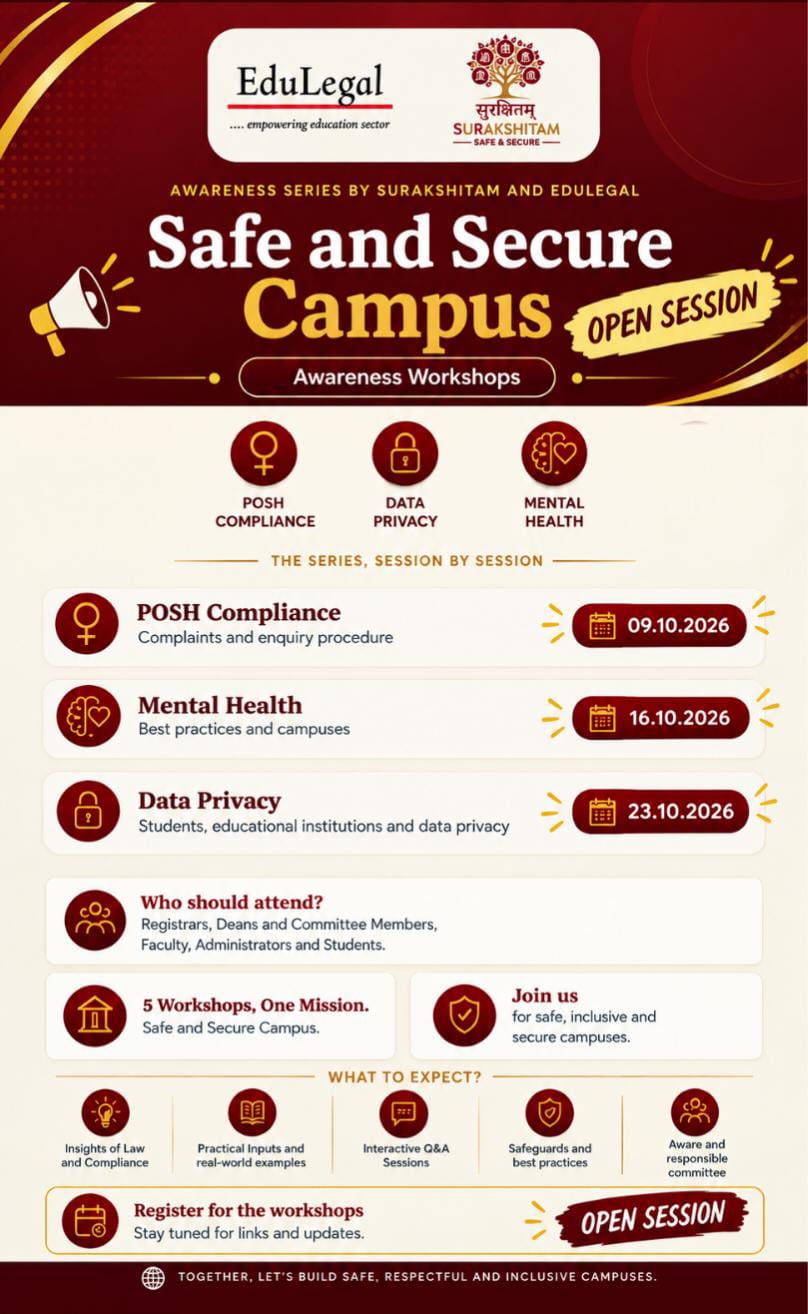
5 Awareness Workshops • One Mission • Safer Institutions.
Educational institutions today are required to address a wide range of legal, regulatory and institutional responsibilities concerning the safety, dignity, privacy and well-being of their campus communities.
Recognising the importance of strengthening awareness in these areas, Surakshitam and EduLegal are pleased to present the “Safe and Secure Campus” Awareness Series.
The series is intended to provide an informed and practical understanding of key issues that educational institutions encounter in their day-to-day functioning. It places emphasis on legal requirements, institutional procedures, compliance responsibilities and good practices.
The workshops are designed to facilitate meaningful engagement with these subjects through practical perspectives, real-world considerations, legal insights, interactive discussions and best practices relevant to educational institutions.
We cordially invite your institution and its stakeholders to participate in this initiative and benefit from the discussions.
A safe campus is strengthened by awareness, preparedness and institutional responsibility.
We look forward to your participation in this important initiative towards building safe, respectful, inclusive and secure educational institutions.
Optional: add a question you'd like us to cover for this session.
Please select at least one topic before submitting the form.
Please post a query for the session. It will help us in curating the topics which we need to address in the webinar.
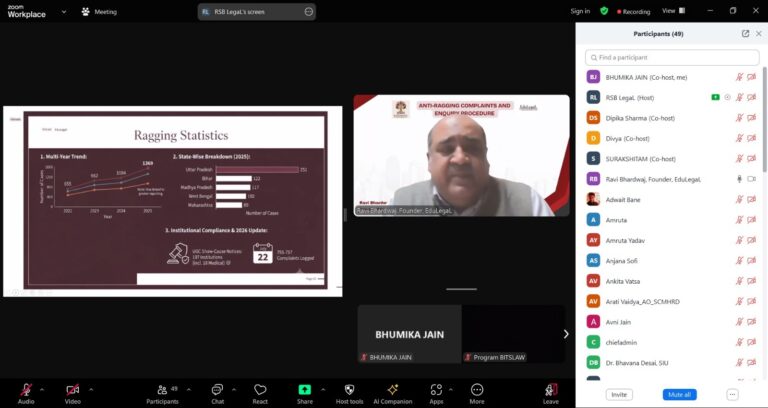
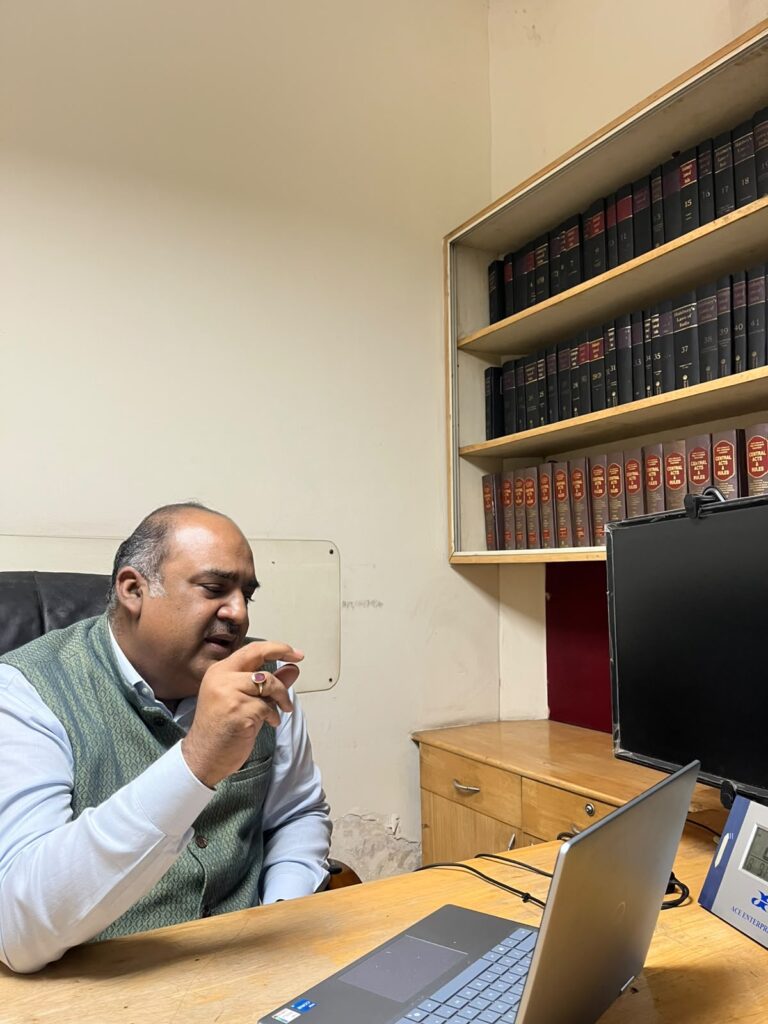
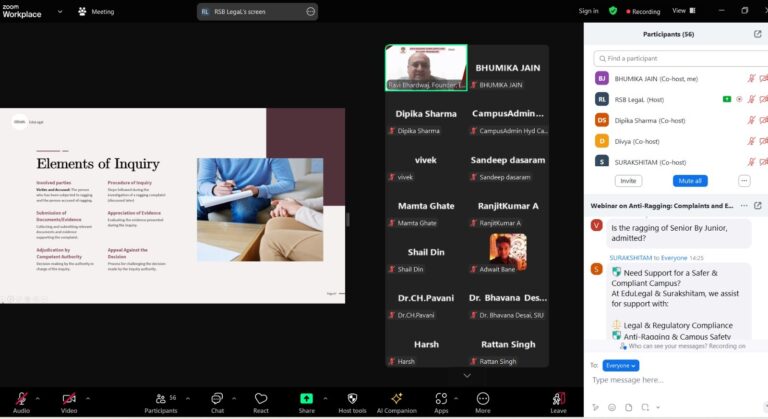
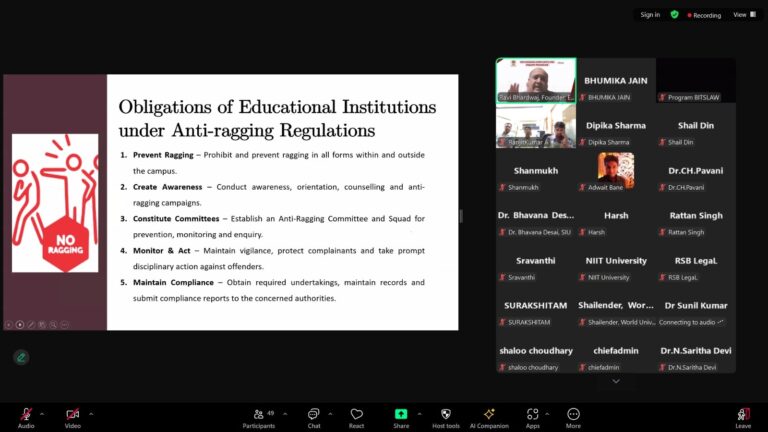
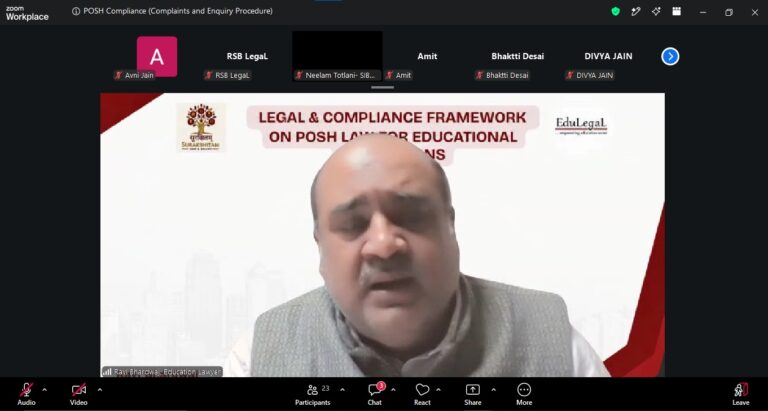
Photos and recordings from earlier workshops in the Awareness Series.
Participant question “How do courts view digital evidence like WhatsApp chats and screenshots? Do they hold good in court — and if yes, under what circumstances?”
Indian courts do accept digital evidence, but only when it clears a few legal hurdles. The framework is the Information Technology Act, 2000 and the Indian Evidence Act, now updated as the Bharatiya Sakshya Adhiniyam, 2023. Courts look at three things: authenticity — can the sender and receiver be identified; integrity — has the record remained unedited and untampered; and procedural compliance — is it backed by the required certification when disputed. Institutional committees — Anti-Ragging Committees and PoSH Internal Committees — must satisfy themselves on authenticity before relying on a digital record.
In practice, it comes down to three situations a committee is most likely to meet:
It is admitted immediately. Take a common situation. A senior student is called before the Anti-Ragging Committee. The complaining student shows a WhatsApp screenshot of threatening messages. The Committee asks, “Did you send this?” He replies, “Yes, I sent it, but I was just joking.”
Once the defending student admits sending the message, the screenshot is accepted as genuine. No further technical validation is needed, and the Committee can turn entirely to what the message means and what action to take.
It is admitted, with no further steps needed. A female student complains of inappropriate messages from a male student on Instagram. During the enquiry the Internal Committee asks the defending student to show his phone, and the messages are found in his sent folder — word for word matching the complainant’s screenshots.
He could not deny that the phone was his, that he sent the messages, or claim the phone was in someone else’s possession at the time. Evidence found on the defending person’s own device speaks for itself, and the Committee can rely on it directly.
A screenshot alone will not be admitted easily. A first-year student files a ragging complaint and shows the WhatsApp chat on her phone. The defending senior says, “That screenshot is fake. I never sent that. She could have faked it herself.”
A standalone image can be disputed — anyone can type a fake conversation, and online fake-chat generators make this trivial. This is where the Committee needs more than the picture.
Think of it this way. If you print a photograph, a court will ask: is this the original, or has it been edited? A Section 65B certificate is a signed statement from a responsible person — the IT head, the system administrator, or the device owner — confirming that “this electronic record is genuine, was produced by a properly functioning device, and has not been tampered with.”
For an Internal Committee or Anti-Ragging Committee, you do not generally need this certificate for your internal enquiry. But if the matter ever reaches a police complaint, a court, or a UGC appeal, and the defending student or faculty member denies the messages, the certificate becomes very important. Without it, a court may refuse to look at the evidence at all.
The practical reality is that most committees do not have an IT team on standby. So the simple rule is: preserve everything on the original device, get a screen recording where possible, and if the matter is serious enough to go to the police, involve your legal counsel.
You do not need to be a technical expert. Your job is to preserve the evidence carefully and record what you did. The legal steps, if needed, will follow.
Participant question “Is there any certification to become a PoSH trainer?”
There is currently no government-authorised or statutorily mandated certification for PoSH trainers in India. Neither the PoSH Act, 2013 nor its Rules prescribe a certifying authority, a fixed curriculum, or a mandatory qualification for conducting PoSH training. In the absence of an official framework, law firms, HR consultancies and boutique training organisations have developed their own certification programmes — several are useful as a structured introduction to the law and case studies, and can be a good place to start.
A certificate on its own does not make someone an effective PoSH trainer, though. Good facilitation in this space draws heavily on lived, practical experience — having sat through real inquiries, understood how institutions actually respond under pressure, and learned to translate the law into examples a room full of people will relate to. That judgment is built over time, through exposure to real cases and real institutions, not from a course alone.
Participant question “How long will a fresher stay Junior in the college? Can a Junior file a case, say in the fourth year, for current or previous ragging?”
“Junior” is an informal, social label tied to the year of admission, not a status the law recognizes. There is no rule that the right to report something is only valid while being “the junior.” A student in the 4th year is exactly as much a “student of the institution” as in the 1st — nothing about that changes.
On filing a case in the 4th year for something from an earlier year, there are two routes:
Unlike PoSH, which has a 3-month window extendable by 3 more, the UGC Anti-Ragging Regulations, 2009 do not prescribe a fixed cutoff for when a student must report. The Regulations focus on how fast the institution must act once it receives a complaint — an FIR within 24 hours and remedial action within 7 days — not on a bar on when the student can come forward.
A long gap can limit what the institution can still do (for example, if the person involved has already graduated), but the institution can and should still record the complaint, investigate, and act where possible.
This depends on which specific offence applies to what actually happened. Ragging itself is not a standalone IPC/BNS offence. Cases are filed under whichever sections fit — wrongful restraint, criminal intimidation, causing hurt, outraging modesty, abetment to suicide, and so on. Each carries its own limitation period under Section 514 BNSS (formerly Section 468 CrPC):
Even where a limitation period technically applies, courts have discretion under Section 519 BNSS to condone delay if there is a genuine, satisfactory reason. Fear of retaliation or academic consequences while still enrolled is a reason courts have recognized before.
Participant question “Under which section/sub-section can students be inducted in the PoSH Committee?”
This is a provision specific to Higher Educational Institutions (HEIs). It does not exist in the PoSH Act, 2013 itself — Section 4 of the Act, which governs a standard corporate Internal Committee, has no student-member category, since the Act is written around “employees.” The UGC Regulations add it specifically for higher educational institutions.
The source is Regulation 4(1)(c) of the UGC (Prevention, Prohibition and Redressal of Sexual Harassment of Women Employees and Students in Higher Educational Institutions) Regulations, 2015.
Three students are to be included on the IC/ICC if the matter involves a student — one each at the undergraduate, master’s and research scholar level. They are elected through a transparent, democratic procedure, not nominated by the administration (unlike the faculty and non-teaching staff members).
They are required only when the specific complaint being heard involves a student, as complainant or respondent. They are not permanent standing members for every case — for example, a pure staff-versus-staff matter does not need them.
Participant question “Is there any mandatory requirement for a psychologist at each College?”
Colleges with 100 or more students must appoint at least one qualified mental health professional — a counsellor, psychologist or social worker with training in child and adolescent mental health. Smaller institutions do not need an in-house appointment, but must set up access to an external mental health professional.
This is not a UGC regulation in the traditional sense. It originates from the Supreme Court’s judgment in Sukdeb Saha v. State of Andhra Pradesh (July 2025), arising from a NEET aspirant’s suicide case. The Court issued nationwide guidelines to prevent student suicides, making it mandatory for all institutions to adopt a mental health policy. It stated that these measures remain in effect and binding until proper legislation or regulatory frameworks are established.
This is binding law right now, not just guidance, pending a formal statute. The bench directed that all educational institutions with 100 or more students must appoint or hire at least one qualified counsellor, psychologist or social worker with proven training in child and adolescent mental health.
On 13 January 2026, UGC circulated its Guidelines on a Uniform Policy on Mental Health & Well-Being for Higher Educational Institutions, prepared by an expert committee. These guidelines require each HEI to establish a dedicated Mental Health & Well-being Centre with appropriate infrastructure for private and accessible services. They mandate one mental health professional for every 100 students, with UGC monitoring implementation through a dedicated portal named MANAS-SETU.
By March 2026, UGC formally directed HEIs to establish Student Services Centres, functioning as a single-window support system equipped with trained counsellors and mental health professionals.
Participant question “Steps involved in anti-ragging”
Participant question “Anti-ragging and enquiry procedure”
Participant question “What is the punishment for students who do ragging?”
Punishment for ragging works on two separate tracks, both of which can apply to the same incident: institutional (administrative) punishment under the UGC Regulations, and criminal liability under general penal law.
Based on the nature and gravity of the offence, the Anti-Ragging Committee can impose any one or a combination of the following:
Right to appeal: a student can appeal the Committee’s punishment order. Where the institution is affiliated to, or a constituent part of, a university, the appeal lies to the Vice-Chancellor of that university.
Ragging itself is not a standalone penal offence under central law. Instead, the Regulations list the specific acts that ragging can amount to — criminal intimidation, wrongful restraint or confinement, causing hurt or grievous hurt, use of criminal force, assault, sexual or unnatural offences, extortion, criminal trespass and abetment — each separately punishable under the IPC/BNS with its own penalty. This is why the institution is required to report the incident to the police and file an FIR, in addition to running its own disciplinary process.
Several states also have their own standalone Anti-Ragging Acts (Tamil Nadu, Kerala, Maharashtra and others) with defined imprisonment terms specific to ragging as an offence.
Participant question “Ragging a girl student by another girl. If the complaint is found to be fabricated. If a fake complaint is given by a girl student on a male faculty.”
The UGC Anti-Ragging Regulations, 2009 are entirely gender-neutral in definition and application. Nothing in the Regulations requires the perpetrator and victim to be of different genders. Same-gender ragging (girl-on-girl, boy-on-boy) is dealt with through the identical process: the same Anti-Ragging Committee and Squad, the same enquiry procedure and the same range of punishments (suspension, fine, rustication, expulsion). The gender of either party does not change the applicable framework at all.
A finding such as “not substantiated” means that the available evidence was insufficient to establish ragging. It does not, by itself, mean that the student lied. A complaint may be treated as fabricated only when there is material showing that the complainant:
If a deliberate fabrication is independently established, the institution may initiate disciplinary proceedings under its applicable student code and grievance rules or other governing regulations. The student must receive notice of the proposed charge, access to the material relied upon, an opportunity to respond and an impartial decision.
At the time of admission, every student and parent submits a sworn Anti-Ragging Affidavit (undertaking). Filing a knowingly false complaint is a breach of this legal declaration and an act of misrepresentation. Under institutional code of conduct rules, the false complainant may face penalties similar to major misconduct, including:
The route depends on what the complaint alleges. A complaint of sexual harassment by a student against a faculty member goes to the Internal Committee under the PoSH Act, 2013 and the UGC Regulations, 2015. Ragging regulations apply to student-on-student conduct, so a complaint against a faculty member is dealt with under the institution’s service rules and conduct framework.
Under Section 14 of the PoSH Act, if the Internal Committee concludes that the allegation was malicious, or that the complainant knowingly made a false complaint or produced forged or misleading documents, it may recommend action against the complainant. For a student complainant, this means action under the applicable student code of conduct.
Two safeguards matter:
Because the stakes are high for both sides, a Committee should not decide that a complaint is false without a clear, recorded finding. It should involve the institution’s legal advisor before recommending any action against a complainant.
Participant question “How to manage PoSH compliance for an educational institution?”
Participant question “Is it necessary to have work experience in the education sector to be an external member of the IC in educational institutions?”
No. Neither the PoSH Act, 2013 nor the UGC Guidelines, 2015 ask for education-sector experience. The external member must be drawn from “amongst non-governmental organisations or associations committed to the cause of women or a person familiar with the issues relating to sexual harassment” — legal knowledge or social-work experience.
The test is therefore commitment to women’s issues, or familiarity with sexual harassment issues, not experience of how a school or university runs.
Participant question “Usage of AI for mental health: AI-based early detection of depression, anxiety and stress; LLM/chatbot-based mental-health support; personalized mental-health interventions; ethical and responsible AI in mental healthcare.”
AI can support campus mental health, but it cannot replace qualified people or the legal duties around them.
The Supreme Court’s Sukdeb Saha directions and the National Task Force’s interim report both emphasise qualified counsellors, referral protocols and confidentiality. AI can extend that capacity. It should not replace it.
Participant question “Steps involved in anti-ragging”
Participant question “Specific duties of warden in each case”
The Regulations place a few duties on the warden by name. The rest come from the duties of the institution, the squad and the committee, which the warden carries out in the hostel.
Participant question “Awareness about the rules and regulations about the laws that support the students”
Constitutional foundation: Articles 14, 15, 19, 21 and 21A of the Constitution cover equality, non-discrimination, free speech, life and dignity (the courts read mental health and education into these) and the right to education for children aged 6 to 14.
Participant question “What is the punishment for students who do ragging?”
Under the UGC Regulations on Curbing the Menace of Ragging, 2009 (Regulation 9), the Anti-Ragging Committee can impose one or more of these, depending on the severity:
Participant question “What constitutes ragging?”
Under Regulation 3 of the UGC Regulations on Curbing the Menace of Ragging, 2009, ragging is defined very broadly. It covers any conduct, by words, writing or acts, that teases, humiliates, frightens or harms a fresher or any other student.
Have a question of your own? and add it when you choose your topics.